
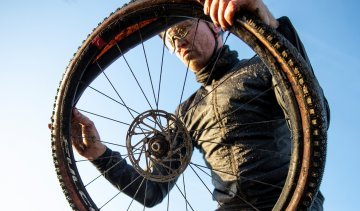
Bicycle inner tubes for road bikes or MTBs: Wha...
Bicycle tube or tubeless tyre? Butyl, TPU or latex? Find out which system is best for you and your bike here.
Find out the optimal tyre pressure for your bicycle tyres and why you’ll roll more easily without sacrificing puncture protection or comfort!
An often underestimated topic for touring, trekking or every day and commuting riders is the correct tyre pressure – yet it often determines whether your ride is fun or frustrating. The right tyre pressure saves you energy, increases comfort, reduces the risk of punctures and can even extend the lifespan of your tyres.
The good news: finding the perfect tyre pressure for your bicycle is easier than you might think. In this guide, we explain everything you need to know as an everyday or touring rider. We decode the mystery of bar and psi and give you practical tips on how to find and set the right tyre pressure.
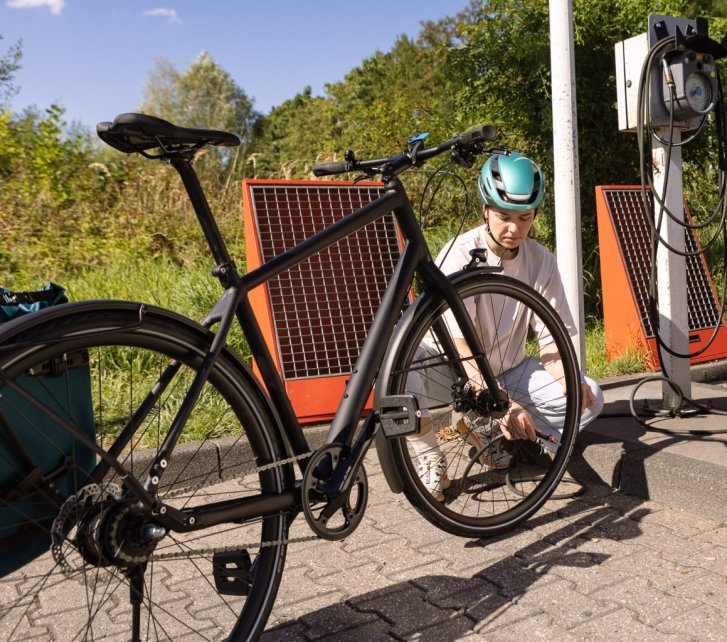
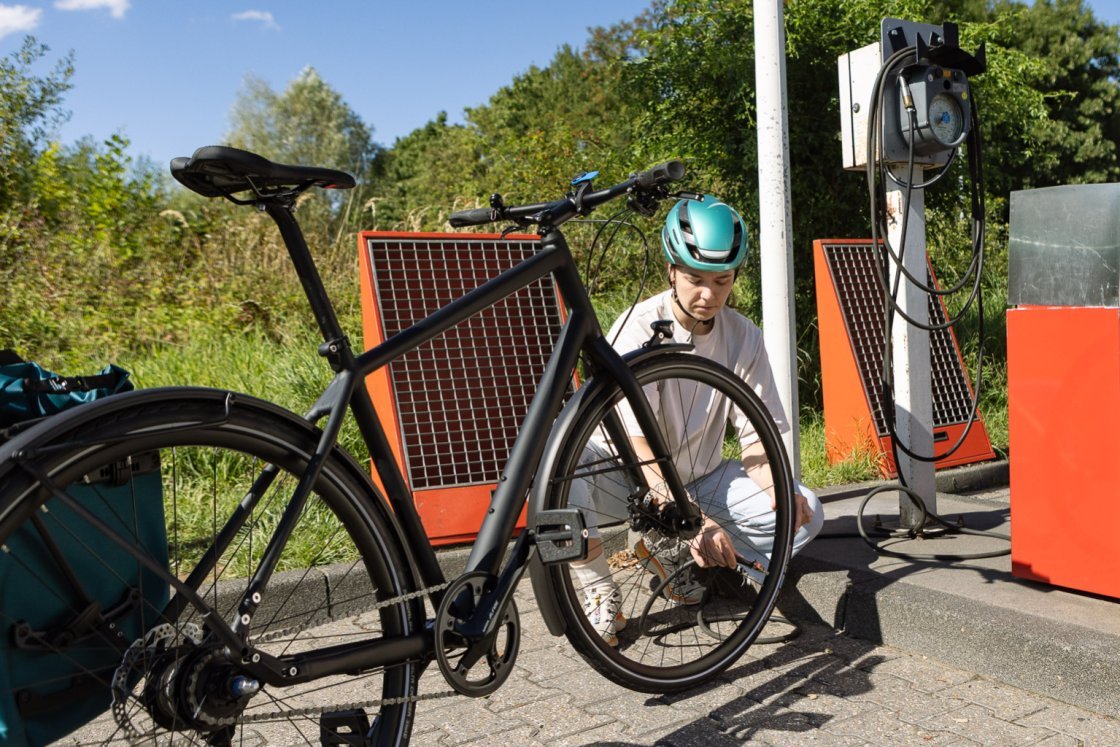
Compressed air is also available at petrol stations — provided your bike has car valves or you have the right adapter with you. © bc GmbH
The optimal tyre pressure is highly individual and depends on several factors. The most important are:
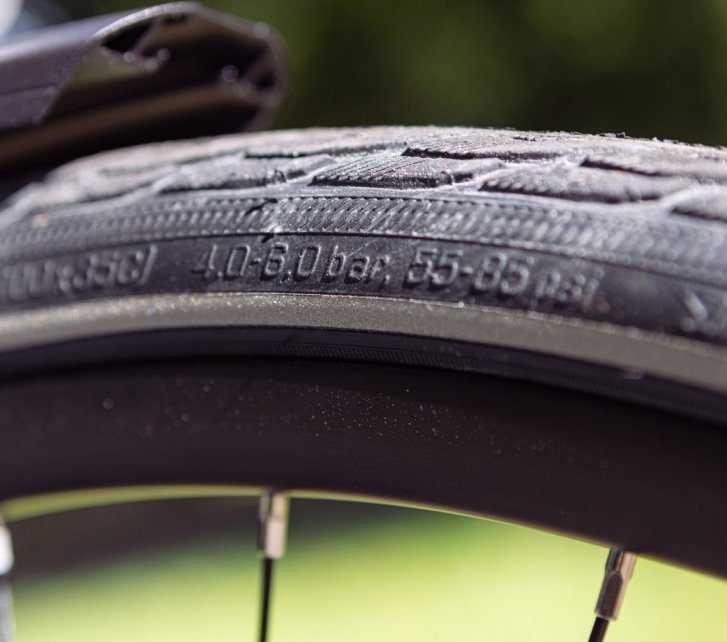
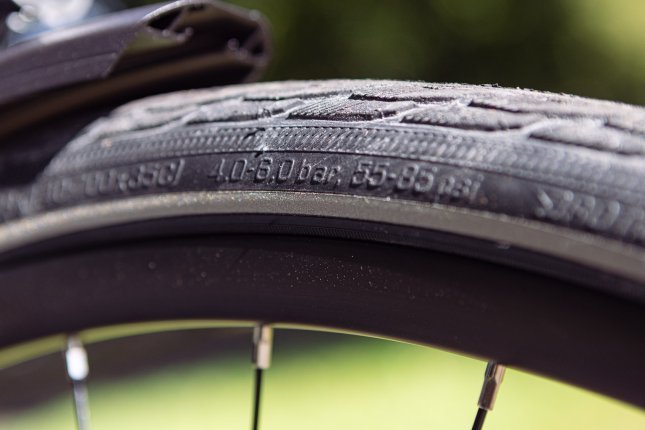
A tyre pressure table can hardly reflect all these differences. That’s why we show you here how to determine the individually correct pressure for your trekking bike or city bike. The specifications on the tyre sidewall for the minimum and maximum permissible pressure of your bicycle tyres form the basis. In addition, you should check the maximum permissible pressure of your rim, as this may be lower.
The load on the tyres is one of the most important factors. This results in the following starting values for your tyre pressure:
Take a test ride with your new tyre pressure and pay attention to how it feels!
After your test ride, it’s time for fine-tuning. Keep the following points in mind:
These adjustments improve comfort, grip and often also the rolling behaviour of your tyres. Carefully work your way towards the right pressure and make sure you don’t go too far. Because if the pressure is too low,
And don’t forget: on the tyre sidewall you’ll find the minimum and maximum permissible pressure values for your bicycle tyres. You must never go below or above these values. You should also check the maximum permissible pressure of your rim.
What is written on the tyre sidewall is law. You should avoid using more or less air than allowed. © bc GmbH
Why do you roll more easily, have fewer punctures and ride more comfortably with optimal tyre pressure? In this chapter, you’ll find out more.
Rolling resistance describes the energy lost as the tyre rolls – with the deformation of the material being one of the main causes. In addition to tyre construction and tread, the combination of tyre pressure and tyre width has the biggest influence on how easily you roll. If you ride with too little or – attention! – too much air in your tyres, rolling resistance increases and you have to push harder on the pedals to maintain speed.
Simply put: on smooth asphalt, a higher tyre pressure with tyres of the same width (!) reduces rolling resistance. The tyre deforms less while rolling, and you go faster. In real life, however, things look a bit different: as soon as the surface is even slightly uneven or rough, tyre pressure should be lower. On cobblestones, forest paths or gravel roads, the pressure must be lower. This allows the tyre to adapt better to the surface, “absorbing” irregularities, shaking you less – and helping you roll faster.
A wider tyre can also be ridden at a lower pressure than a narrower tyre – without negatively affecting rolling resistance. This is due to the tyre’s contact patch: a wider tyre has a wider but shorter contact patch than a narrow one. It deforms less, rolling resistance is lower, and it still absorbs uneven ground better – meaning a wider tyre makes you doubly fast. If you plan to switch to wider tyres, check compatibility with your bicycle frame and fork, any mudguards and the rim width (specifically the inner rim width).
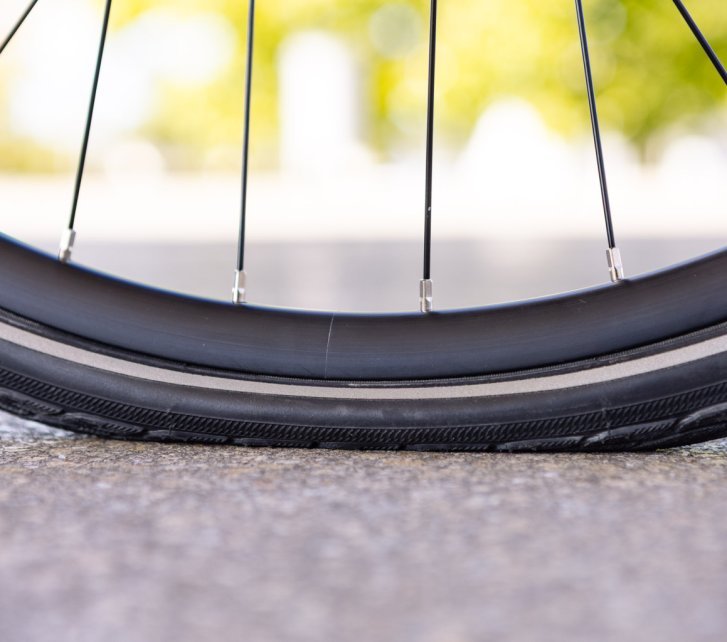
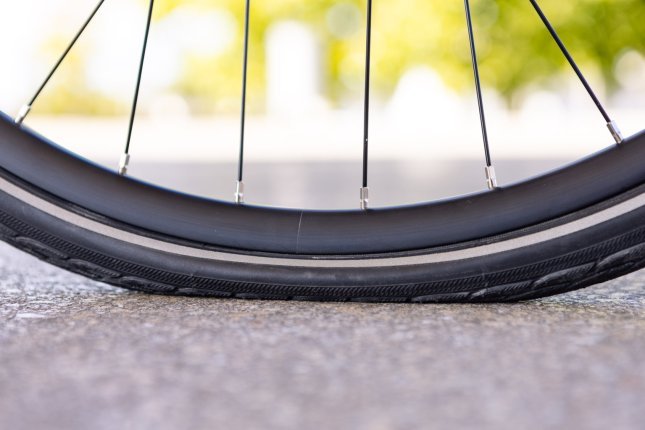
If you ride with too little air, you waste muscle power on tyre deformation, get a spongy ride feel and suffer pinch flats more quickly. © bc GmbH
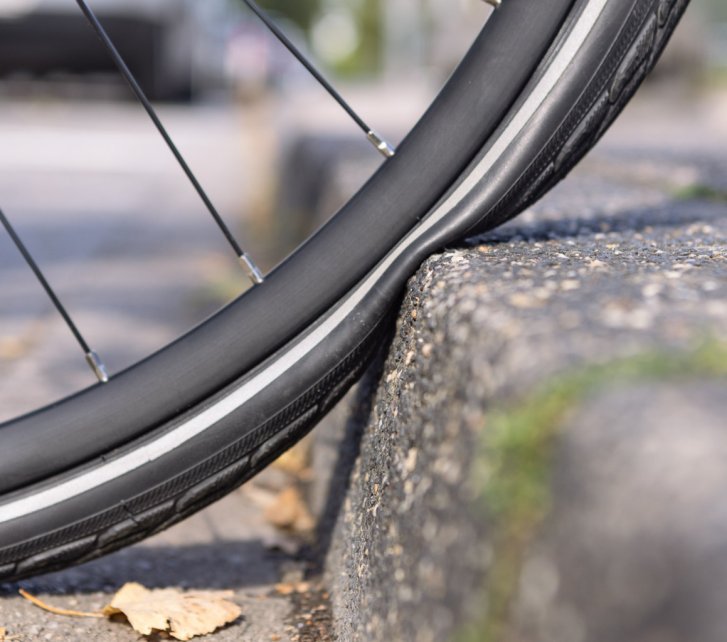
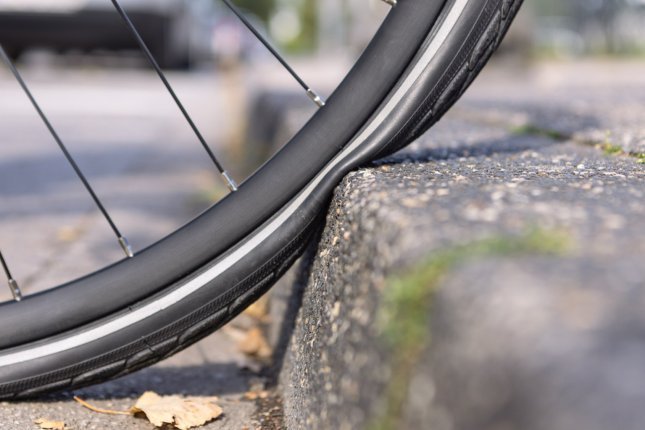
With too little air in the tyre, the risk of punctures increases. One particularly problematic issue is the so-called pinch flat. If your tyre with insufficient pressure hits an obstacle, for example a kerb, the tyre can bottom out against the rim. The inner tube becomes pinched between the rim and the obstacle. The result is a “snakebite”: a flat tyre with two small, characteristic holes in the tube – resembling bite marks. Attention: besides the tube, your tyre or rim can also be damaged.
Ouch! With too little air, hard obstacles can damage the tube, the tyre or even the rim. © bc GmbH
But more isn’t always better: a slightly lower tyre pressure can work wonders on all kinds of terrain. Damping is improved and your ride becomes more comfortable. Whether on cobblestones or forest paths – with the optimal tyre pressure, your tyre takes over part of the suspension and you ride better.
With the optimal tyre pressure, the tyre contacts the ground with an ideal contact patch. If the pressure is too low, the sidewalls can buckle, tear and the tyre deforms more than necessary while rolling. This increases wear and makes it uneven.
With the right tyre pressure, your tyre lasts longer and punctures occur less frequently. This not only saves your nerves but also your wallet.
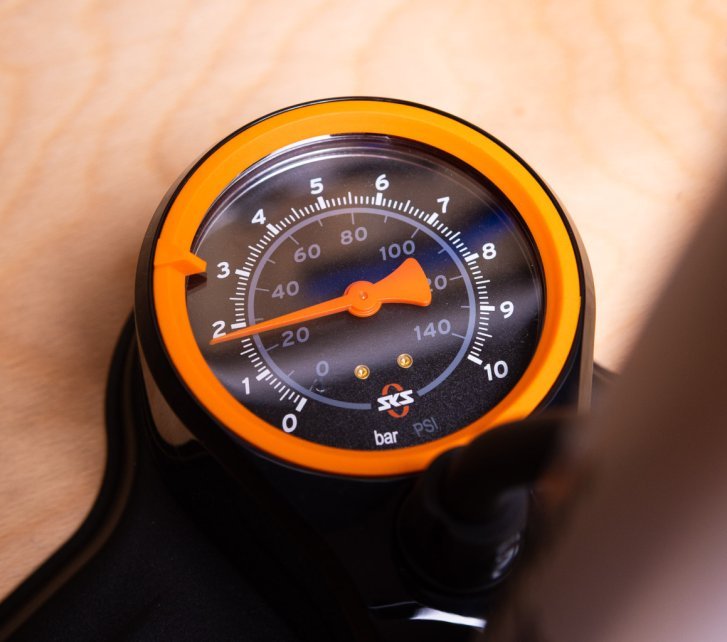
Different regions use different standards – and this also applies to tyre pressure. Depending on the country, pressure is measured either in bar or psi. While bar is common in much of Europe, psi (“pound-force per square inch”) is mainly used in North America and the United Kingdom. If you ever need to convert your pressure, a simple rule of thumb helps: 1 bar is approximately 14.5 psi.
Most pumps with a pressure gauge display both units. You can easily switch your digital pressure gauge between bar and psi.
Ultimately, what matters is this: no matter which unit you use, your tyre pressure should suit you and your bike.
Bar and psi are simply different units for the same purpose. Whether you prefer to stay with bar in the metric system or switch to psi in the imperial system is a matter of preference. © bc GmbH
Once you’ve determined the correct tyre pressure for your bicycle tyres, it’s time to set it – and check it regularly. How often you need to reach for the pump depends on your tyre or tube system, your optimal pressure and the ambient temperature. You should also be prepared when you’re out and about; a puncture kit is part of the basic essentials.
Note that pressure readings are not always comparable between different pumps and pressure gauges – similar to a scale that hasn’t been calibrated. Once you have determined the correct tyre pressure for your bike using your device, this value applies only to that specific device and often cannot be transferred to other pumps or pressure gauges.
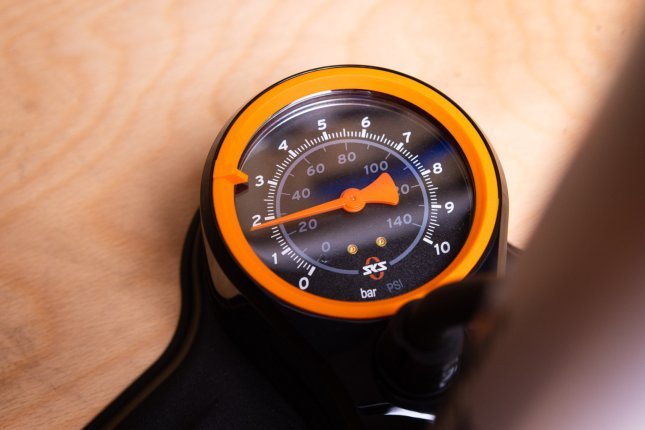
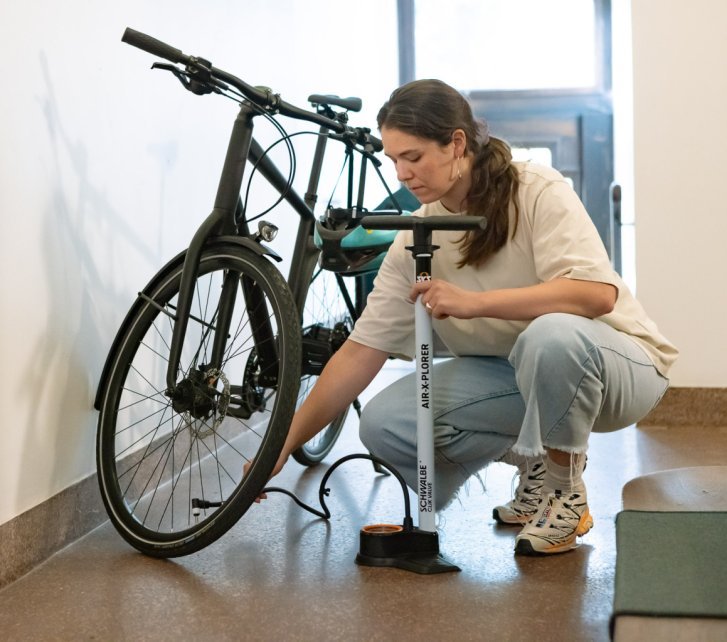
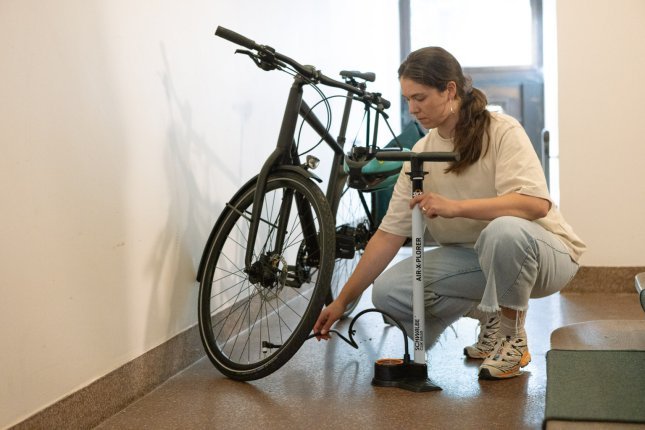
If you ride your bike regularly, we recommend a floor pump with a pressure gauge for home use. It allows you to top up air easily or fully inflate your tyres after changing a tube or tyre. Make sure the gauge is easy to read! It should be large enough for you to see the value clearly.
At home, a good floor pump is the best choice for achieving the correct tyre pressure. © bc GmbH
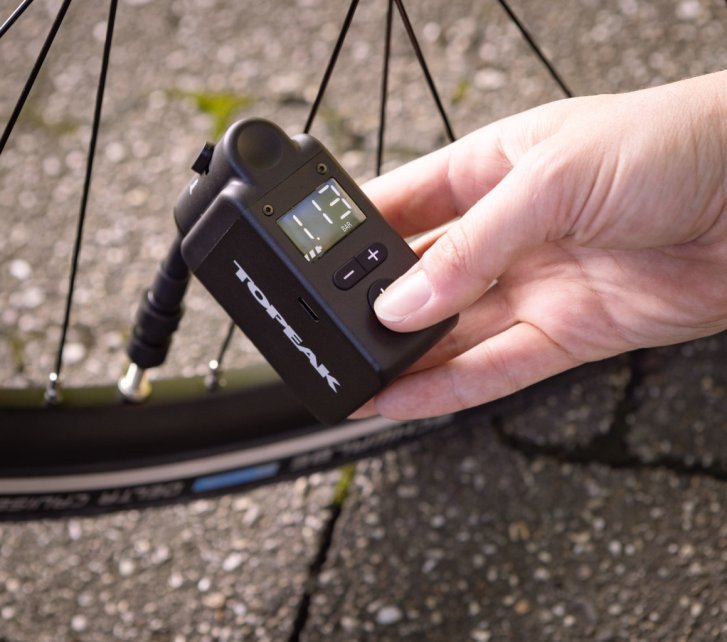
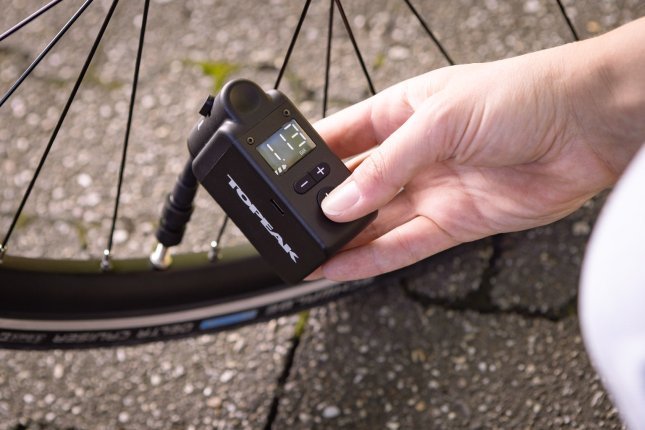
For emergencies on the road, a mini pump belongs on your bike or in your backpack. Alternatively, there are compact rechargeable air pumps – technically mini compressors – with digital pressure control. They make pumping on the go easier and prevent tired arms. Pay attention to the battery capacity and don’t forget to recharge your pump regularly! Otherwise, it might only fill half a tyre.
Compact rechargeable pumps are fairly new and help you achieve accurate tyre pressure with ease. © bc GmbH
If you want to be very precise, a digital pressure gauge will help. It allows you to check the pressure accurately at home or make sure on the go that you’ve reached the desired pressure with your mini pump.
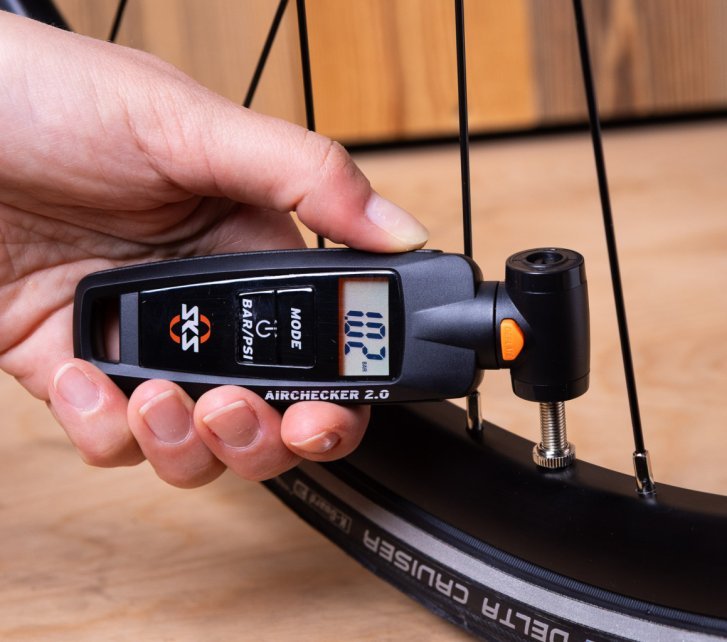
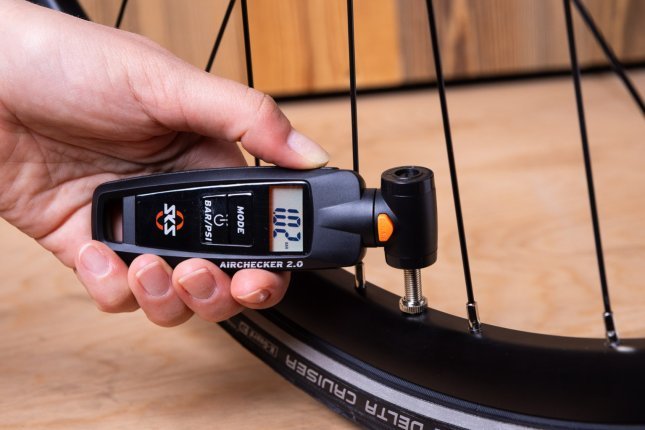
Pressure gauges like the SKS Airchecker are the most accurate way to measure your tyre pressure. © bc GmbH
As a rule of thumb for a standard inner tube: check the pressure before every longer ride and at least once a month – preferably more often. bicycle tubes continuously lose air, so regular checks are key to good handling and puncture protection.
Too little pressure is the most common cause of punctures. The bicycle tyre also feels “spongy”, making steering imprecise. More importantly, the risk of a pinch flat (also called a “snakebite”), where the tube gets trapped between the rim and a kerb, increases dramatically. Rolling resistance also rises, so riding becomes significantly harder.
Yes, it can. Every tyre has a maximum pressure printed on the sidewall (e.g. “MAX. 6.0 BAR”). This must never be exceeded. Too much pressure also makes the ride very uncomfortable, as every bump is transmitted directly to you, and it reduces tyre grip on the road.
A slow loss of air over several days or weeks is normal. But if your tyre loses noticeable pressure overnight, there is usually a defect. The most common causes are a tiny hole in the tube (e.g. from a thorn) or a faulty valve.
Yes, indirectly. In theory, pressure decreases slightly in cold temperatures and increases in heat – but this is barely measurable. More important is adjusting to wet conditions: in the rain, it can be useful to lower the pressure by about 0.5 bar. This increases the contact patch and improves grip on slippery surfaces.
Most pumps have a gauge with two scales. One shows bar, the other psi. In Europe, bar is the most commonly used unit.
Yes, a wider tyre makes a big difference. The main rule is: the wider the tyre, the less pressure is needed to support the same rider weight. A wide tyre (e.g. 50 mm) offers more comfort and grip at lower pressures without significantly increasing rolling resistance.
No. Since most of the weight sits on the rear wheel, it is common practice to run about 0.2 to 0.3 bar more pressure in the rear than in the front. This improves grip and comfort at the front and ensures sufficient puncture protection at the rear.
Bicycle tube or tubeless tyre? Butyl, TPU or latex? Find out which system is best for you and your bike here.
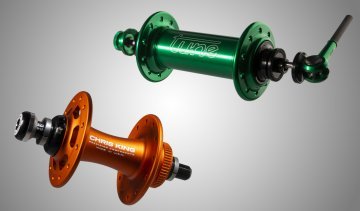
Which thru axle is the right one for your hub? We give you an overview of the common dimensions of hubs and axles on MTB, road bike and gravel bike.

Perhaps you’re familiar with the basics, but do you want to learn more about the physics behind a wheel? Allow us to give you an in-depth explanation.

Is it worth building a custom wheelset for a road bike when there are so many good system wheels available? Absolutely! Read on to learn more.
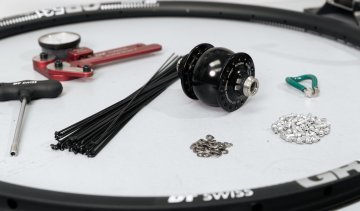
A hub dynamo provides power for lights and charging smartphones and GPS on the bike. We’ll show you what to look out for when building a dynamo wheel.
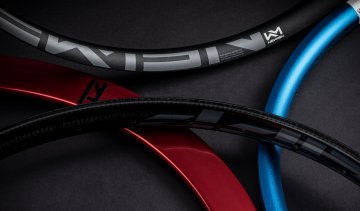
Looking for a new rim for your bike? We’ll show you what to look for when choosing the right rim for your MTB, road bike or gravel bike.
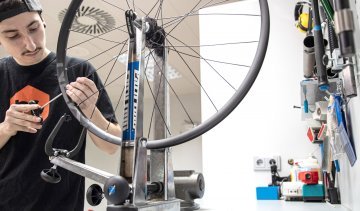
The question: system wheelset or build your own wheel? We explain the basics for picking out rims, spokes and hubs.
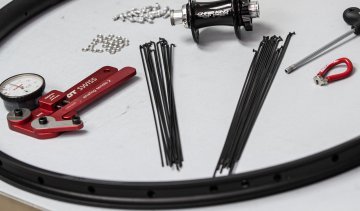
Have you ever thought about building your own MTB wheelset? We’ll give you ten reasons to build your own custom wheelset.
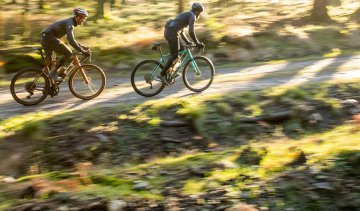
A gravel wheelset has to withstand a lot of hard use. Can't find the right one? Build it yourself! We’ve put together some tips to help you get started.
Send your unused goods back within 100 days after purchase and get your money back!
See more