
How To: Inspect Your Bike
Ready for the season? We’ll show you how to prepare your bike for the upcoming season and which parts require special attention.
Gearing for gravel bikes needs to meet specific demands. By now, there's a wide selection of gravel gearings on the market. Here's an overview for you.
Initially, gravel bikes were mainly equipped with road bike components. However, it quickly became clear that gravel gearing has somewhat different requirements. While precise gear ratios are crucial on a road bike, gravel bike gearing needs to offer more: once you turn off-road, lighter ratios become useful, for example for bikepacking. Gravel bike gearing should also be robust and resistant to dirt. Today, you no longer need to combine mountain bike and road bike parts: gravel groupsets unite the essential aspects of both worlds. Either way, with our tips you will find the right gearing for your gravel bike.
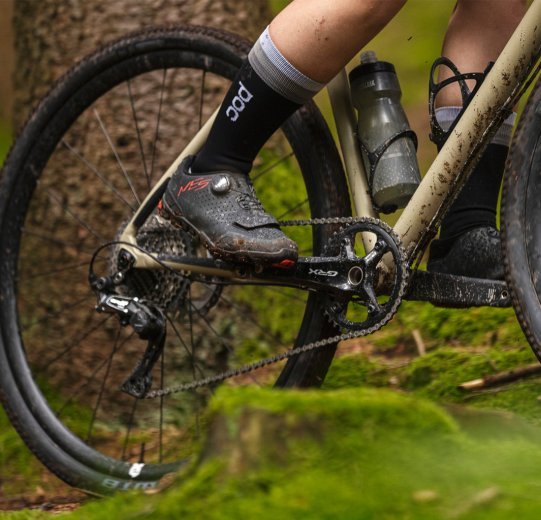
Unlike a road bike, with a gravel bike it is especially important that you can shift smoothly across uneven terrain.
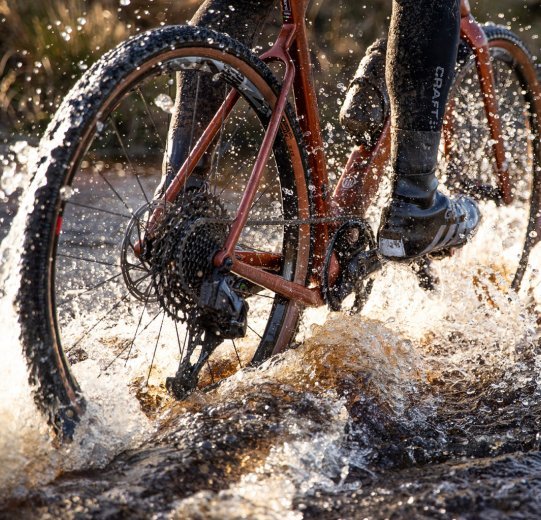
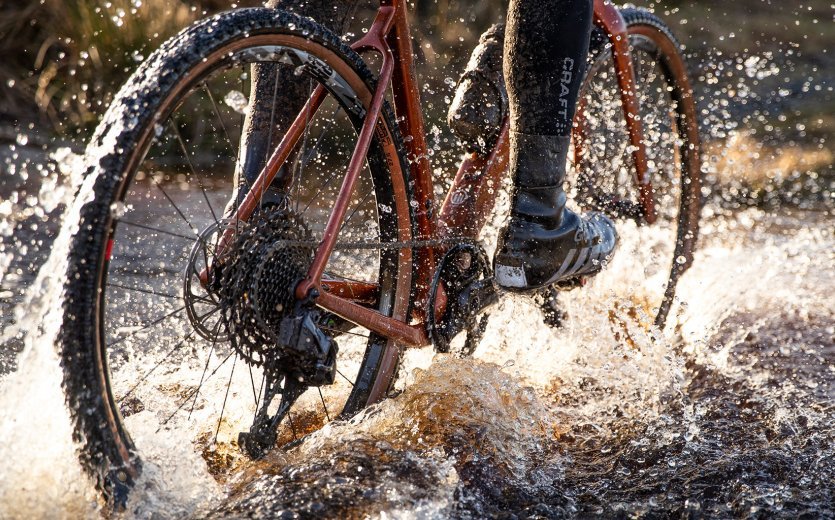
Since you often go across water and dirt when gravel riding, the gears of your bike should be able to withstand a lot.
A complete groupset for gravel bikes includes the rear derailleur, cassette, crankset, chain, shift/brake levers, and brake calipers. In a group with multiple chainrings, the front derailleur is of course also included. If you're building your new bike yourself and order a complete groupset, you're making sure all parts match - both visually and functionally. Upgrade kits usually come without cranksets and brakes, some also without cassette and chain. They allow you to upgrade specific parts while keeping others or choosing them individually. With wear sets, you have the option to only replace the wearing parts.
The range of usage for gravel bikes is broad, and so are the possible gear ranges and gradations. Groups with a single crankset offer advantages off-road: they are quiet, lightweight, perform better in dirt, and look cleaner. With cassettes featuring ten to thirteen sprockets, you can choose between fine gradation and a wide range. This allows you to tailor the groupset to your needs.
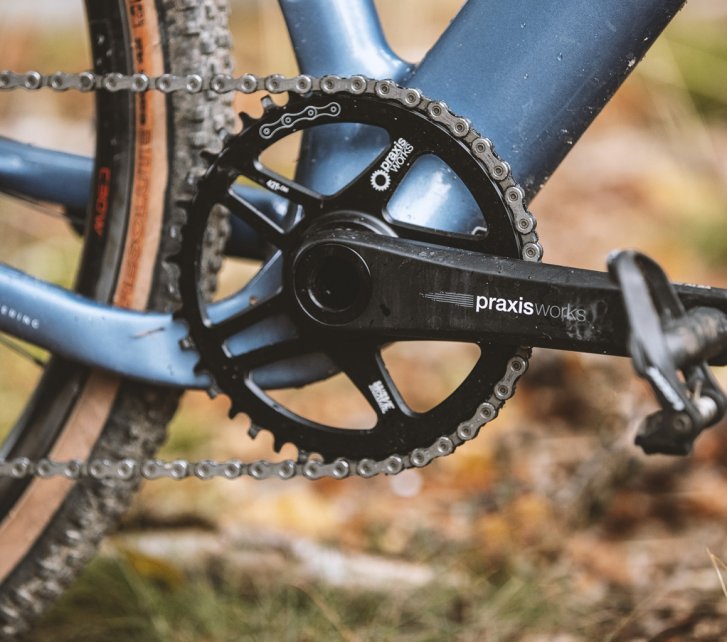
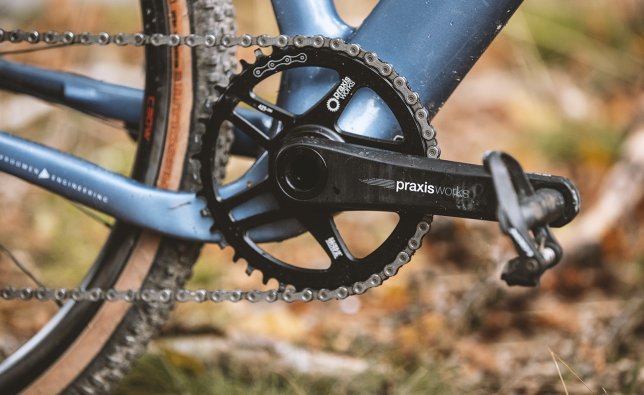
Chainrings with alternating narrow and wide teeth (narrow-wide) prevent the chain from dropping. Eliminating the second chainring and the front derailleur leaves more room for wide tyres and allows for shorter chainstays. Because of this, some gravel frames are only compatible with single cranksets. If your frame allows the installation of a double crankset and a front derailleur, you gain the option of both fine gradation and a wide gear range. Use the filters in our shop to narrow down the selection by gear stages on the crankset and cassette.
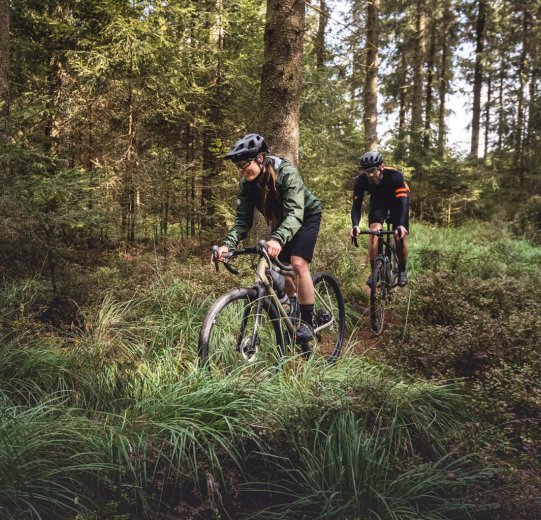
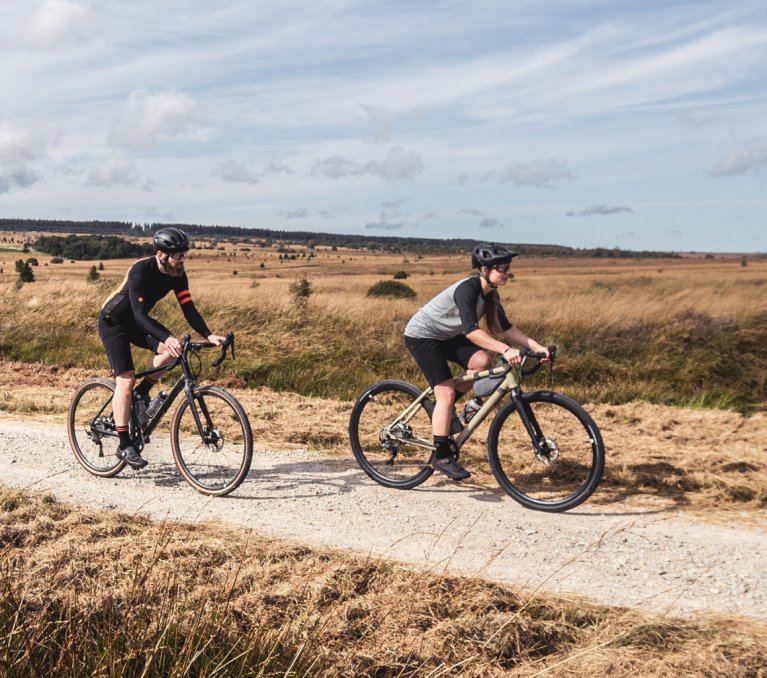
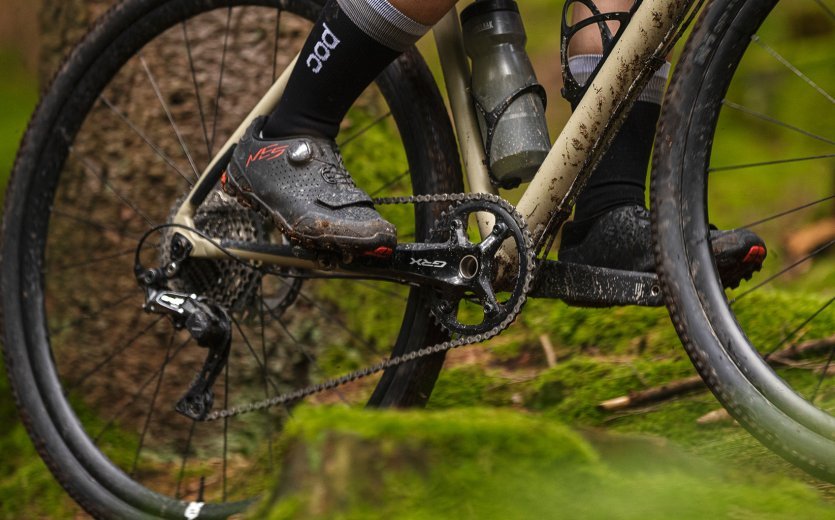
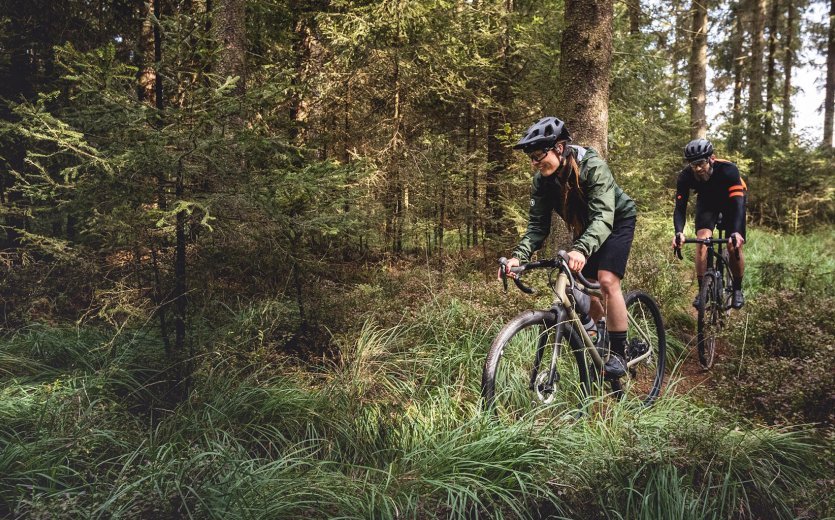
Gravel riding is fun on forest paths and trails...
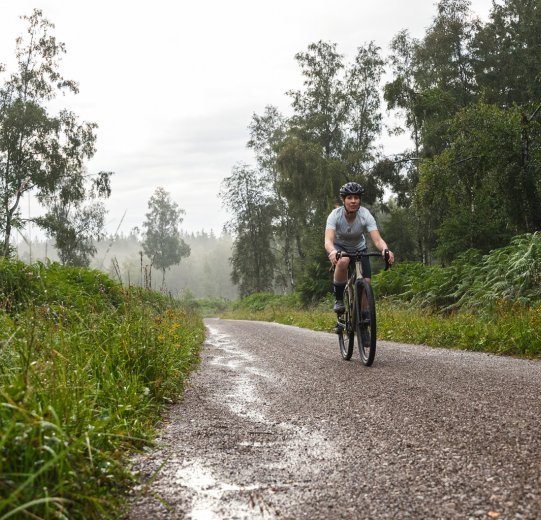
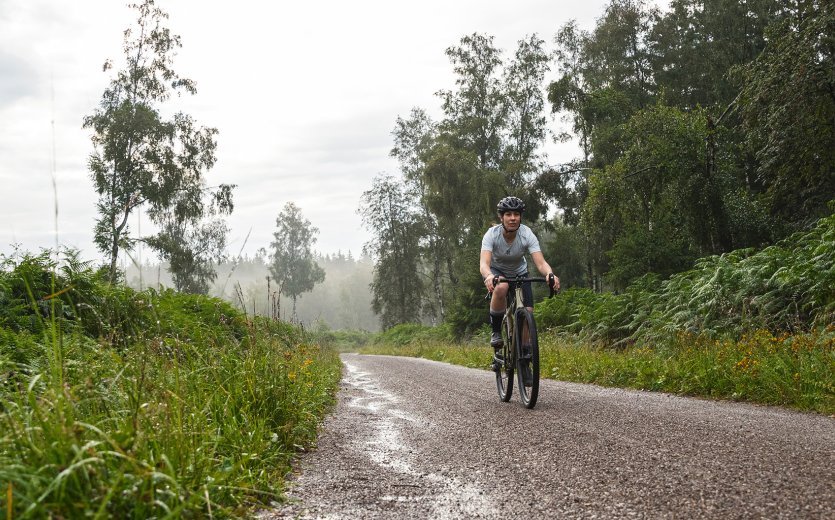
... but just as often leads you over gravel roads.
Disc brakes are standard on gravel bikes. The current groups come with powerful hydraulic brakes that offer excellent modulation and work reliably and almost maintenance-free thanks to automatic pad adjustment. To mount the brakes on your bike, you should pay attention to the type of brake caliper mounts. Shimano, SRAM, and Campagnolo provide their groups suitable for most gravel frame sets with flat mount brakes. If your bike has post mount or IS mounts, in some cases you can mount flat mount brakes with adapters. It’s best to check with the frame manufacturer. SRAM offers post mount brakes with shift/brake levers separately.
Tip: It’s a good idea to order one or two pairs of compatible replacement brake pads right away.
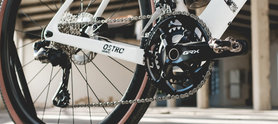
The complete Shimano GRX groupsets are available in several versions that differ in number of gears, shifting system, signal transmission, price, weight and finish. As of 2026, the flagship model is the GRX RX827. It is one of Shimano’s first Di2 groupsets to shift completely wirelessly, using a local battery or coin cells in the rear derailleur and shifters.
The GRX RX825, RX820, RX815 and RX810 are the established high-end groups. All GRX 800 series groups use the highest-quality materials. The crank arms are hollow to reduce weight.
Just below the top tier are the GRX RX600, RX610 and RX717 (or RX710) groups. The 600 series adopts the rear derailleur and front derailleur from the corresponding 800 series but saves costs on other components to improve value for money. For example, the crank arms are not hollow. Thanks to more cost-effective materials and manufacturing processes, these groups are slightly heavier, but functionally they make no compromises. With RX717, Shimano introduced another wireless groupset that uses its own rear derailleur and shifters, while relying on components from the 600 series.
As an affordable entry into the world of gravel groupsets, Shimano offers the GRX RX400.
The table below shows which GRX variants are available as electronic Di2 (wireless or wired) and which gear options they offer:
| GRX | 2x12 gears | 1x12 gears | 2x11 gears | 1x11 gears | 2x10 gears |
| Di2 (wireless) | – | RX827 | – | – | – |
| Di2 (wired) | RX825 | – | RX815 | RX815 | – |
| Mechanical | RX820 | RX820 | RX810 | RX810 | RX400 |
Note: Individual component model numbers may differ (and are often higher) than the groupset designation. This is because different configurations require specific parts. For example, 2x12 and 2x11 groups require differently designed rear derailleurs than 1x12 and 1x11 setups. But don’t worry: if you buy a complete groupset, all included components are perfectly matched.
Below GRX, Shimano now also offers Shimano Cues Drop Bar in several versions – with mechanical or hydraulic disc brakes, nine, ten or eleven cassette sprockets, and with or without a front derailleur. You will mostly find Cues on complete bikes rather than as aftermarket groupsets. The same applies to the entry-level Shimano Essa Drop Bar group with eight speeds and mechanical disc brakes.
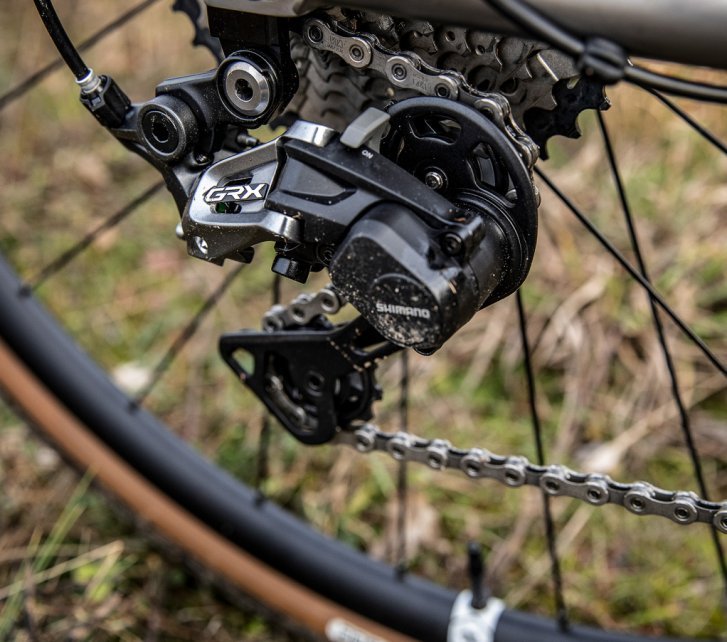
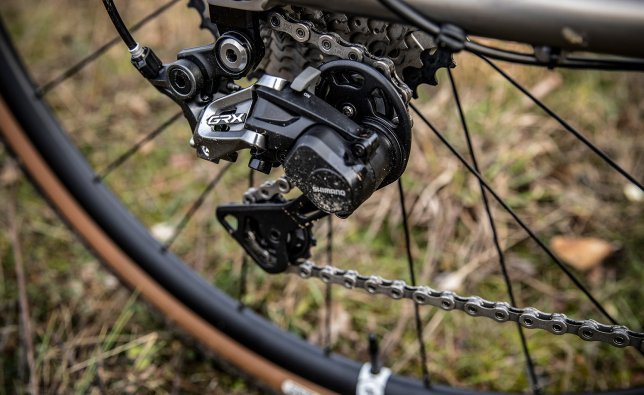
The mechanical rear derailleur of the Shimano GRX groupset can be used with both 1x11 and 2x11 gears. © bc GmbH
With the Ekar, Campagnolo offers a high-end groupset for your gravel bike. There is no front derailleur, but instead you get 13 sprockets. Carbon is used in both the crankset and the rear derailleur, and only the best materials are used throughout. The Ergopower shift/brake levers have been optimized for gravel riding and come with a redesigned thumb lever.
SRAM divides its gravel bike groupsets into three categories with different gear gradations:
The top groupset for gravel bikes is the SRAM Red XPLR AXS 1x13. Here you get the latest technologies, the highest-quality materials, and the most precise workmanship. The key differences compared to the 1x12 Red are the wider cassette range, the adjusted gradation, and the robust and precise Full-Mount interface of the rear derailleur for frames with UDH (Universal Derailleur Hanger). The twelve-speed Red groups (1x12-XPLR and 2x12-All-Road) are just as impressive in terms of quality, lightweight construction, and machining. The Force groups also use high-quality materials (such as carbon crank arms), but are not quite as light. Just below sits the Rival – slightly cheaper because the most expensive materials are omitted. Apex is the entry into SRAM’s gravel shifting world. It is available not only as a wireless AXS version but also mechanically with a cable.
A Mullet setup with Eagle components is not available as a complete groupset but only as an individual combination of parts from the MTB, road, and gravel segments. You can mix quality levels – but always make sure to check compatibility.
Attention: SRAM uses different mounting standards for its derailleurs. Some, such as the 1x13 XPLR AXS units (Red, Force, and Rival) and Eagle Transmission MTB derailleurs, require frames with UDH dropouts. SRAM calls this “Full Mount”. The new technology is more robust and more precise but is not compatible with frames that have classic derailleur hangers.
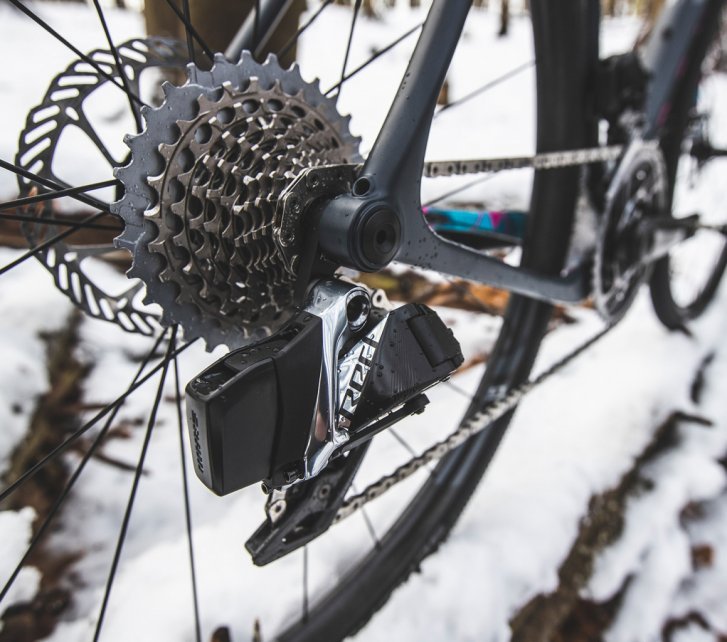
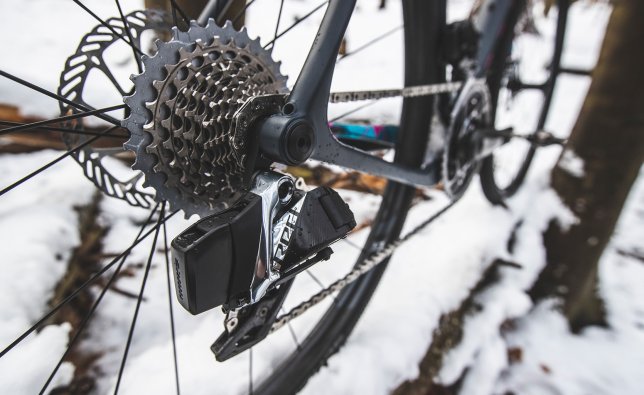
From Shimano, SRAM and Campagnolo, you can also get mechanical groupsets – shifting systems that use a cable. The technology is reliable and well-proven. As an alternative, Shimano offers its electronic Di2 system, which depending on the model can be wired, partially wireless (semi-wireless), or, since 2025, fully wireless. For its high-end complete groupsets, SRAM relies entirely on electronic options using its wireless AXS technology. Mechanical shifting is usually found in the entry-level segment. We explain the advantages of electronic systems in a dedicated article.
Whether you want to use mechanical or electronic shifters & derailleurs is a matter of taste - both systems have their advantages. © bc GmbH
In the product description, pay attention to which type of freehub body the cassette is designed for. Shimano, SRAM, and Campagnolo use different systems. The cassette must match your hub!
Alternatively, many hubs can be converted by swapping the freehub body. We explain how to understand and convert freehub bodies in this article. If you're unsure whether you have the correct groupset in your cart, feel free to contact us!
In the shop, you will often find several variants of the gravel groupsets. If you look closely, you will see the differences in the product name. For Shimano, these include the chainring size as well as whether the group comes with or without a front derailleur. For Campagnolo, it is only the chainring size. For SRAM, the addition “Wide” in the title means that the crank has a slightly more outward chainline to create more clearance for wide tyres. In some cases, the chainring size is also listed. Once you have selected a groupset, you will usually still have to choose the version. Options here include crank length and cassette gradation. With wired Shimano Di2 systems, in some cases you can also choose between an internal or an external junction.
You should carefully read the product description and the listed scope of delivery. In many cases, we've provided links to products that you need to order separately to complete your setup. In most cases, for example, brake rotors and adapters for mounting the brakes are not included with the complete groupset. The same applies to bottom brackets. For Shimano’s wired electronic shifting systems, the necessary cables must also be ordered separately.
Gravel bikes are used in such diverse ways that the selection of complete groupsets can hardly cover every possible need. If you have specific ideas, you can also assemble your own groupset from individual components. Especially for cranksets, chainrings, cassettes, and chains, there are also other manufacturers. However, you should pay particular attention to the compatibility of the parts with one another. Even components from different groups or model years of the same manufacturer do not automatically work together. If you ride your gravel bike mainly on asphalt and well-maintained gravel paths, you can also take a look at road groupsets.
For that extra portion of individuality on your drivetrain, manufacturers such as e*thirteen offer compatible components. © bc GmbH
To install a groupset, you will need a few specific tools in addition to Allen and Torx wrenches. For replacing the cassette, you need the appropriate cassette remover and a chain whip. To remove the old chain and size the new one correctly, you'll need a chain tool. A pair of master link pliers can also be helpful.
For precise derailleur setup, SRAM includes a very useful setup gauge. If you want to shorten the brake lines, you'll need the correct bleeding kit. As with tools in general: look closely! Your old chain tool might not be compatible with the narrow chains of the 1x13 groupset. The same is true for the chain whip or cassette remover.
Ready for the season? We’ll show you how to prepare your bike for the upcoming season and which parts require special attention.
Here you’ll find an overview of the most important technologies and components for shifters & derailleurs on MTBs, road bikes and everyday bikes.

They shift quickly & precisely: electronic shifters & derailleurs are now used on many high-quality bicycles. An overview of various systems.
XTR, XX1, X01, Deore, etc. – The choice of shifters & derailleurs for MTBs is huge. Find out which is the right one for you here.
Whether you’re a sprinter or a mountain enthusiast, a nerd for classics or a fan of light materials, our tips will guide you to the right road bike system.
How does the freehub on a bike work? What should you pay attention to when converting shifters & derailleurs, which freehub is compatible with which models
Send your unused goods back within 100 days after purchase and get your money back!
See more