

infoFor technical reasons, the Part Scout service is currently unavailable. If you have any questions about our products, our customer service team will be happy to help.


Find replacement parts for your bike easily.
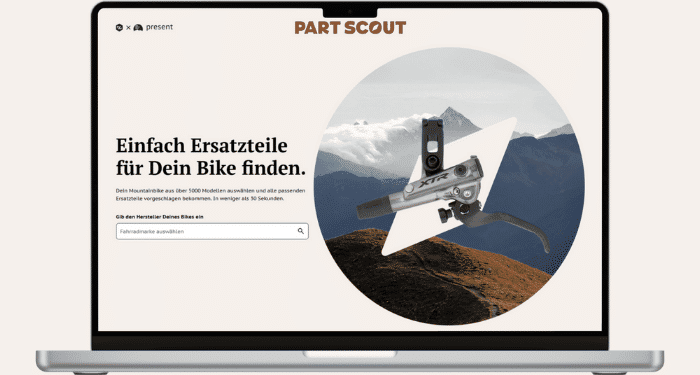
Part Scout is your smart bike parts finder that shows you, within seconds, which replacement parts truly fit your bike. Simply enter the brand, model and year – and instantly discover compatible components, including suitable alternatives.
Note: Part Scout is currently available in German only. An English version will be released shortly.

How much offset does my chainring have? Which cassettes fit my rear derailleur? Which brake pads, headsets or even bottom brackets are compatible – and what on earth is Super Boost?
If you do your own bike maintenance, you know the seemingly endless maze of technical standards and measurements in the cycling world. Even seasoned mechanics get confused. And worse: if you’ve just started wrenching on your bike, or you’re planning a complex project like a rebuild or a major upgrade of an older model, you’ll spend hours researching compatible parts – and still risk buying the wrong ones, wasting time, money and resources. Part Scout is here to make finding the right replacement part massively easier for you.
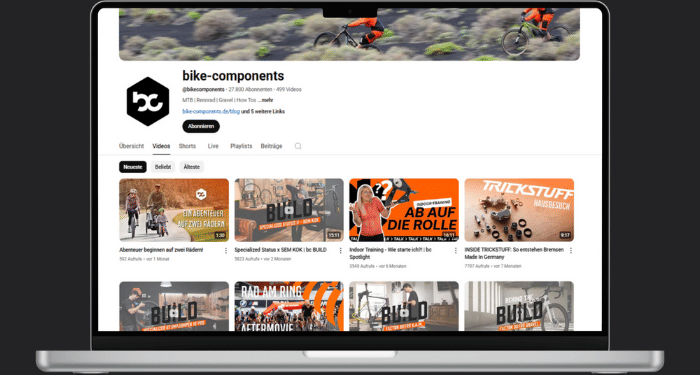
TIP: Whether you’re changing your tyres for the first time or you’re an experienced home mechanic, you’ll find plenty of guides, how-tos and even real-time repair tutorials on our bike-components blog and YouTube channel:
The problem: a jungle of bike industry standards
Unlike the automotive industry, there’s no central authority for standardisation in the bike sector. For decades, numerous small and medium-sized manufacturers have introduced their own technical standards – and once these are out in the world, they’re almost impossible to get rid of. Technological progress has also required new standards: wider axles with the Boost standard, even wider with Super Boost, or more robust derailleurs in the SRAM-developed Direct Mount (or UDH) ecosystem are just a few prominent examples. To make things even more complicated: nobody would install Toyota seats, a Maserati steering wheel and a Porsche engine into a BMW. Cars are, in essence, consistent products from a single manufacturer, whereas most bikes combine components from a wide range of brands into one functional whole – often maintained or upgraded by the riders themselves.
This is exactly where Part Scout comes in – guiding you safely through the maze of technical standards and compatibility to help you find the right parts for your bike.
How Part Scout works
Step 1: Enter your bike brand



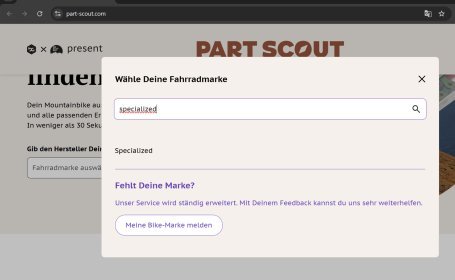
Step 2: Select your bike model

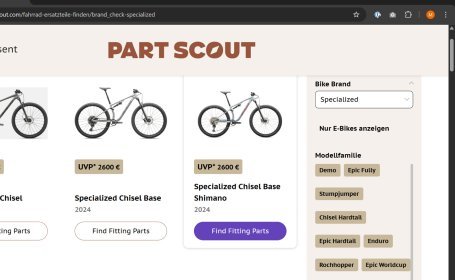
Step 3: View all compatible replacement parts at a glance

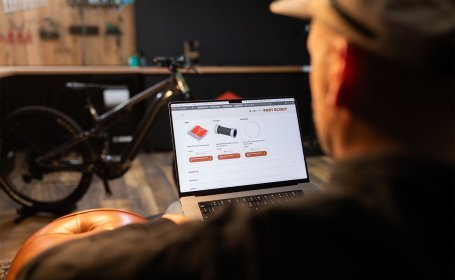
Step 4: Select your desired replacement part


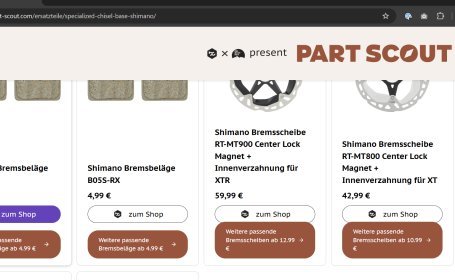
Which parts can I find with Part Scout?
Part Scout helps you find compatible replacement parts for your MTB and e-MTB. This naturally includes common wear parts such as chains, cassettes, chainrings, brake pads or tyres. But Part Scout also shows compatible drivetrain components, the right headset, seatposts, wheels and suspension parts for your bike. You can even find a new matching stem or handlebar with Part Scout.
At launch, the Part Scout database already includes more than 5,000 MTB and e-MTB models from over 60 brands, covering model years from 2021 to today. The database is constantly growing. If your bike is missing from Part Scout, just send an email to feedback@part-scout.com so that the Part Scout team can add the data for you.
While this smart parts finder currently covers around 5,000 bikes from more than 60 MTB and e-MTB brands, expansions for road bikes, gravel and urban bikes as well as e-bikes are already in progress. It’s worth checking back regularly to follow the ongoing development of the Part Scout database.
TIPPCreate a bookmark right away with Ctrl + D (Windows) or Cmd + D (macOS).

Your benefits
In cooperation with
Ride Better Bikes
FAQ: Questions & Answers
Part Scout – Questions & Answers on usage
Spare parts & technology – More questions about bike maintenance
Service & use
Where can I buy the bike spare parts?
At bike-components.de. The matching items are linked directly from Part Scout to the bc online shop, and you can complete your order as usual with your bc customer account.
Part Scout can’t find my bike. What should I do?
Contact us here so that we can add all compatibility details for your bike to Part Scout. Currently, Part Scout focuses on classic MTBs and e-MTBs from model year 2021 onwards. Expansions to cover older bikes and other categories – from road to cargo bikes – are already in progress.
Which parts does Part Scout suggest?
Part Scout identifies matching original parts as well as compatible alternatives from OEM suppliers and third-party manufacturers. The selection is based on criteria such as price, popularity and originality.
Will the replacement part really fit my bike?
Please double-check before ordering whether the components originally installed by the manufacturer are still fitted to your bike. Differences can occur, for example, with:
- used bikes that have been modified with different components
- custom builds from framesets
- changes made by the manufacturer (e.g. due to supply shortages)
Which prices are shown in Part Scout?
Part Scout displays the current prices from bike-components.de. This smart spare parts finder is a free service – there are no extra charges or hidden costs.
How up to date are the bike and parts databases in Part Scout?
The Part Scout databases for bike models are continuously updated and currently include model years back to 2021. The compatible parts displayed are always those currently available at bike-components.de.
Compatibility & selection guide
Is there a general compatibility chart for bike parts from different manufacturers like Shimano or SRAM?
A general compatibility chart for bike parts from different manufacturers such as Shimano or SRAM is practically impossible to create in a complete and centralised form, since many parts use brand-specific technologies and standards. With Part Scout, you’ll find the right parts for your specific bike in just a few steps.
Which bike parts are largely universal or particularly easy to replace?
Some bike parts offer great upgrade potential with virtually no compatibility issues – such as handlebar grips, pedals or saddles (the latter especially in the MTB sector). Here, the world of technical standards is refreshingly simple – anyone can experiment freely.
How can I tell if a bike part is suitable for my mountain bike or e-bike?
Even if you just want to check whether a specific part fits your bike, you can use Part Scout to quickly see which technical standard is compatible. You should always verify the exact specifications in the product description or, if you already own the part, on the packaging.

Drivetrain & use
Which chain is the right one for my Shimano Deore 12-speed drivetrain?
For chains, the decisive factor is the number of sprockets on your cassette: the more sprockets there are, the smaller the spacing and the narrower the compatible chain needs to be. In addition to all Shimano 12-speed chains, you can also use chains from third-party manufacturers such as KMC or Wippermann Connex with a Shimano Deore 12-speed drivetrain. In principle – except for SRAM’s Flattop chains from the Transmission ecosystem – a SRAM chain will also run on your Shimano drivetrain. However, if you expect optimal shifting performance, mixing manufacturers is not the best choice. Make sure that your new chain has the same number of links as the original one. Usually, you’ll buy the next longer chain and shorten it to the required length using a chain tool.
Which bike cassette fits which freehub body (e.g. Shimano HG, Micro Spline, SRAM XD/XDR)?
Each manufacturer has one or more proprietary freehub systems. Shimano traditionally uses the HG freehub body and the newer Micro Spline standard, while SRAM calls its standard XD. Note that especially older bikes may not be compatible with 12-speed drivetrains – in case of doubt, check with Part Scout.
My new rear derailleur shifts inaccurately – is it a compatibility issue or an adjustment problem?
Both are possible – and it’s hard to tell from a distance. If you’ve confirmed that your new derailleur matches the technical standard of the old one (for example, Shimano 12-speed), it’s most likely an adjustment issue. You can find detailed instructions in our article on how to adjust a rear derailleur on an MTB.
E-bike specifics
Are special e-bike chains and cassettes really more durable – and necessary for motor use?
E-MTBs are no mystery, but they’ve rightly earned a reputation as drivetrain killers. In addition to generally higher mechanical forces, factors such as motor overrun combined with rough shifting habits and the typically higher mileage of e-bikes play a major role.
E-bike-approved drivetrain components such as cranks, chainrings, cassettes or chains are tested to withstand higher loads than traditional MTB parts. You can recognise them by the “E-bike ready” logo.
Do standard mountain bike cranks fit every e-bike motor (e.g. Bosch, Shimano, Brose), or are there special interfaces?
Cranks differ significantly between traditional, non-motorised MTBs and e-MTBs. Where a conventional MTB has a bottom bracket, most e-MTBs – such as those using Bosch, Shimano, Specialized, TQ or Fazua systems – have a drive unit instead. Since the motor already contains a spindle, only cranks that are compatible with your bike’s motor system can be installed.
What is a UDH (Universal Derailleur Hanger) and what advantages does it offer?
The UDH standard was introduced by SRAM and refers to the direct or “full mount” attachment of the rear derailleur to the rear dropout of an MTB or e-MTB without a traditional derailleur hanger. UDH derailleurs, such as SRAM’s Transmission models, are designed to be easier to adjust and more robust than conventional versions. Especially with the higher torque loads typical of e-MTBs, UDH components can fully demonstrate their strengths.
Brakes
Are there significant differences between Shimano brake pads, or can I use any Shimano pad?
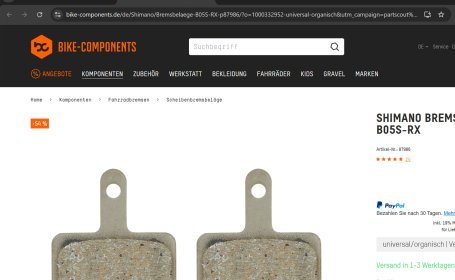
First and foremost, the brake pad must be the correct one for your brake. If you use Part Scout, you don’t need to worry about compatibility – and the compatible brake models are also listed on the packaging. While organic brake pads are the choice for most everyday cycling applications, sintered metal brake pads withstand higher temperatures, tend to last longer and deliver better braking performance in wet and hot conditions than their softer counterparts. Sintered pads are therefore the preferred option for long, steep alpine descents, downhill, enduro and bike park riding, as well as for consistently wet conditions.
Can I use Magura brake pads in Shimano callipers, or the other way round?
A classic Part Scout question! Brake pads from different manufacturers are not compatible – and anyone who tries will quickly find out when attempting to fit them. There is, however, one exception: the high-end brake specialist Trickstuff from Freiburg (see our Trickstuff visit here!) offers a wide range of high-performance pads designed for different brake systems from SRAM to Shimano.
Which brake rotor fits my bike hub – 6-bolt or Centerlock mount?
A quick look at your bike or in Part Scout will reveal the answer: 6-bolt rotors are attached to the hub with six bolts through the corresponding holes, while the Centerlock standard uses an external or internal toothed lockring to secure the rotor. If you don’t feel like measuring your rotor diameter, you can usually find it laser-engraved directly on the rotor itself.
Upgrades & tuning
Can I fit tubeless tyres on any standard bike rim?
You can, of course, ride MTB tubeless tyres with an inner tube. However, if you want to convert your wheels to a tubeless setup, your rims should be “tubeless ready” and the rim bed must first be sealed with tubeless rim tape. In our article “Converting to tubeless”, we show you exactly how it works and which parts and tools you’ll need.
Can I install a suspension fork with more or less travel on my mountain bike – and what are the consequences?
When fitting a new suspension fork, there are several important things to consider. In addition to a matching steerer tube, you should check with your frame manufacturer which installation height is approved. In short, a longer fork increases the leverage forces acting on the head tube. Whether that exceeds your frame’s limits must be verified before any conversion. A longer fork also alters your bike’s geometry: head and seat angles become slacker, and the bottom bracket sits higher. Whether that still results in a rideable setup depends on your bike and is hard to predict in advance. Common sense usually helps here: instead of forcing a downhill fork into your down-country bike, you might simply consider getting another bike!
Didn’t find the answer you were looking for? No worries – just get in touch! For anything related to Part Scout, drop us a line at feedback@part-scout.com. If your question is about our products or buying advice at bike-components, our customer service team will be happy to help – by email or phone.
More from bike-components
The bc YouTube channel: Step-by-step in real time