



How To: Inspect Your Bike
Ready for the season? We’ll show you how to prepare your bike for the upcoming season and which parts require special attention.
Spring curve, negative chamber and shim stack – clear so far? If not, our mountain bike suspension glossary has you covered.
You want to dive deeper into the topic of mountain bike suspension? You know what suspension and damping are, but what exactly are low-speed compression and offset bushings for?
This glossary helps you quickly look up terms before you make a mistake, or when you're unsure during product selection. Of course, you can also work through it in one go to understand the complex relationships of suspension and its various tuning options. In that case, we recommend grabbing a coffee.
Air is the most widely used spring medium in mountain bike forks and shocks. It has two decisive advantages: Air is extremely light and the spring rate can be changed very easily and precisely by adjusting the air pressure with a shock pump. The higher the pressure in the air chamber, the stiffer the spring. Air has a progressive spring curve, protecting better against bottom-outs than a steel spring.
In many suspension elements, air is the spring medium. The pressure determines the spring rate. To adjust the air pressure in a fork or shock, you need a shock pump. The pressure is given in psi (pounds per square inch). You can linearly convert psi to bar: 14.5 psi = 1 bar.
If the spring rate and/or progression of a suspension element is too low, a bottom-out can occur, for example when landing after a jump: the fork or shock blows through to the end stop. Light bottom-outs are okay, but regular hard bottom-outs are not good for the components and put you in borderline situations regarding bike control. Therefore, regularly check the air pressure (for air suspension elements), not just in the tyre!
The break-away force is the force that your fork or shock must overcome to transition from a static to a dynamic state, i.e., to compress or rebound. Static friction at the various seals must be overcome, but the spring medium also plays a role. Since the pressure in an air spring is quite high, a negative spring is used, allowing the suspension to respond sensitively.
The 'bridge' refers to the arch that connects the lower legs of the casting. It serves to stiffen the casting and can also be used to mount mudguards. Note: Dual-crown forks should actually be called dual-crown forks rather than double bridge forks – see also Fork Crown. Special case: Upside-down forks have no bridge.
Slide bearings or bushings are used in both shocks (also: suspension struts) and forks. The shock requires 2 mounting bushings as a link between the shock eye and the frame, allowing it to rotate smoothly during compression and rebound. These bushings are wear parts and can wear out – which will almost certainly lead to noises in your rear end. You should check this during the small shock service and replace the bushings if necessary. There are special offset bushings as aftermarket parts with which the frame geometry can be influenced to a small degree. However, this is almost unnecessary for the average rider and requires a sensitive feel for geometry.
The slide bushings cannot be seen from the outside – they guide the stanchions of the fork in the lowers and in the shock the shaft in the shock body, ensuring the fork works with little friction but also without play. If the bushings are worn, the fork has so-called bushing play. This manifests similarly to a loose headset through wobbling of the components against each other.
In conventional fork construction, the casting refers to the lower part, i.e., the outer lower legs including the bridge. This component is manufactured using a casting process (English: 'to cast'), hence the name. See also Stanchion and Lower Leg. Upside-down forks are constructed differently.
Clicks describe the detent mechanism in which you can set and reliably reproduce compression and rebound damping. Mechanically, a click is generated by a small steel ball running in a groove and pressed into a depression by a small spring. This is perceived as a click – less audible, but clearly felt in your finger.
A key component of suspension elements are the sliding surfaces. These are the tubes that telescope into other tubes during suspension movement. They are guided by internal slide bushings and cleaned by dust wipers (also called main seals) during compression – these also keep the oil inside. To ensure the suspension responds sensitively and sustains as little damage as possible even under dirt and rock impact, the surface of the sliding areas is carefully finished and hardened. This is usually not an applied coating, but an anodizing process in which the surface of the workpiece is chemically opened and then sealed again with additives. Fox, for example, uses the typically golden Kashima coating from Miyaki on its Factory models, where the aluminum pores are enriched multiple times with a molybdenum-sulfur compound. The surface finishing is designed so that an oil film adheres better to the surface, further reducing friction.
The compression damping controls how a suspension element compresses (hence: compression). An open compression means little damping and a sensitive, fast compression. With a closed compression, the shock or fork compresses with more damping, i.e., more slowly. In high-quality suspension elements, high-speed and low-speed compression can be set independently. Low-speed compression is responsible for slow movements such as pedaling, while high-speed handles fast movements such as hard hits or jump landings.
In contrast to the shock (strut) component, damping is a function found in every suspension element. More on this in our detailed article on suspension and damping. Damping determines when a suspension element compresses or rebounds and how quickly. It is primarily adjusted according to your preferences and riding style. It is broadly divided into rebound damping and compression damping. The damping medium is oil (open bath or closed cartridge).
Forks with a lot of travel (around 200 millimeters) feature two crowns instead of one fork crown, providing the fork legs with more stability. The crowns sit below and above the head tube. This makes installation somewhat more complicated and limits the steering angle of the bike, but provides more stiffness required for hard downhill use.
In addition to steel and air springs, elastomers once played an important role on mountain bikes. Today, such shock-absorbing plastic elements can be found at most in minimalist systems on cross-country softtails, gravel bikes, on children's or folding bikes, and in suspension seat posts. Another niche are forks with carbon leaf springs.
The crown of a suspension fork is the component that connects the fork steerer tube with the two legs (stanchions).
For a few years, various suspension forks have been offered with different offsets. If you choose a fork with a smaller offset, you increase the trail of your front wheel with the same head tube angle, reducing the wheelbase but adding more straight-line stability. Forks with a larger offset reduce trail: The bike steers more nimbly – despite the larger wheelbase.
The fork steerer tube connects your fork to your bike's frame and cockpit (stem and handlebar). Most steerer tubes today are tapered, meaning conical: They have an outer diameter of 1 1/5 inches (38.1 mm) at the bottom, directly above the fork crown, and 1 1/8 inches (28.6 mm) at the top, where the stem clamps. Via the length of the steerer tube (and spacers), you can adjust the height of your cockpit. Between the fork steerer and the frame's head tube, two headset bearings are mounted.
There are heated debates in MTB forums about the installation direction of shocks. Some say: Install the shock so that its lighter side (usually the piston rod) is actuated by the rocker link. This improves responsiveness through less unsprung mass. Others say: Install the shock so that the piston rod points downward, which improves lubrication of the seals. Still others say: It doesn't matter, you won't notice the difference anyway. We say: Whatever you do, definitely carry out a collision check and make sure that the shock and (if present) reservoir (piggyback) do not strike the frame during compression.
The installed length indicates how long a shock measures from shock eye to shock eye (center to center) in the unextended state. It is specified either in inches or millimeters. The installed length correlates with the shock stroke, but does not determine it. Depending on the kinematics of the rear suspension, even small changes in installed length have massive effects on frame geometry and suspension. A too-large installed length raises the bottom bracket and creates steeper seat and head tube angles, while a too-short installed length has the opposite effect. Please only install shocks with the specified values for stroke and installed length.
Rear suspension kinematics refers to the geometric relationships of the rear wheel suspension. This includes leverage ratios that, together with the shock stroke, determine travel, and can also create mechanical progression. The factory basic setup of the shock (see also shims) should match the kinematics of the frame. Kinematics also influences braking and drive inputs (e.g., pedal kickback) as well as the wheel path curve.
A true lockout completely blocks a fork or shock to prevent unwanted bobbing, for example during a road climb. To fully block the suspension, the oil flow is locked by closing a valve. Many systems have a mechanism that briefly opens the valve on strong impacts to avoid damage from overpressure. True lockout systems have largely been replaced by platform damping, which responds more subtly to different terrain situations.
Negative travel has nothing to do with the negative spring. It is the portion of total travel by which the suspension element compresses when you sit or stand on your bike. It should be between 20 and 35 percent of total travel. This allows the wheel to both compress and rebound, ensuring optimal traction and control. Negative travel is influenced by the spring rate.
Since the air chamber in forks and shocks is under pressure even in the unextended state, unlike a steel spring it is always heavily preloaded. Modern shocks and forks get around this problem with a negative spring. It counteracts the force exerted by the preload and at least partially cancels it out, so the suspension element can respond sensitively even to the smallest bumps. The negative spring has nothing to do with negative travel (sag).
With eccentric shock bushings (offset bushings), the effective installed length of a shock can be reduced or increased by a few millimeters. The desired effect: head tube and seat tube angles become slacker or steeper, and the bottom bracket sits lower or higher. The concrete geometric effects on riding feel are limited – this is more fine-tuning and cannot fundamentally change the character of a bike.
The viscosity (flowability) of the oil in fork and shock influences the riding characteristics. At very cold temperatures, the suspension element becomes slow and sluggish, while in intense heat it becomes very responsive – however, the damping properties are also somewhat lost, so you may need to readjust with the adjusters.
Most forks and shocks feature a rubber o-ring that helps you easily determine the negative travel (sag) of the suspension element. The o-ring also tells you at any time how much total travel of the fork or shock you have used.
Steel or titanium springs can usually be preloaded via an adjuster. The preload acts like an additional weight on the spring and compresses it accordingly. Although a preloaded spring feels harder, preload does not change the spring rate. A preloaded spring only reacts to impacts stronger than the preload, with noticeably worse responsiveness. If a spring is too soft for the system weight, install the next-harder spring. Preload adjusters primarily serve for fine-tuning of negative travel (sag).
A spring's progression describes how the spring rate increases as travel is used. The spring curve visualizes this: a linear spring always increases force by the same factor, while a progressive spring requires an ever-increasing force to compress further. Higher progression protects against bottom-outs. It can be tuned with volume spacers or via frame kinematics.
Platform damping is a preset, quickly engageable compression damping. Manufacturer names such as Climb Switch or Pedal Control explain the meaning: With a lever on the shock, fork, or remote on the handlebar, compression damping can be quickly increased to prevent the suspension from moving due to pedaling force on smooth uphills, which consumes pedaling energy. On rough terrain, platform damping should be left open.
Rebound damping controls how quickly a suspension element rebounds. Without damping, the wheel would jump uncontrollably when rebounding. The higher the air pressure or spring rate, the faster a suspension element rebounds with constant damping. The higher the damping, the slower the rebound. On high-quality forks and shocks, high-speed and low-speed rebound can be set independently. Low-speed rebound influences the range of low travel usage, while high-speed rebound acts primarily when using the full travel.
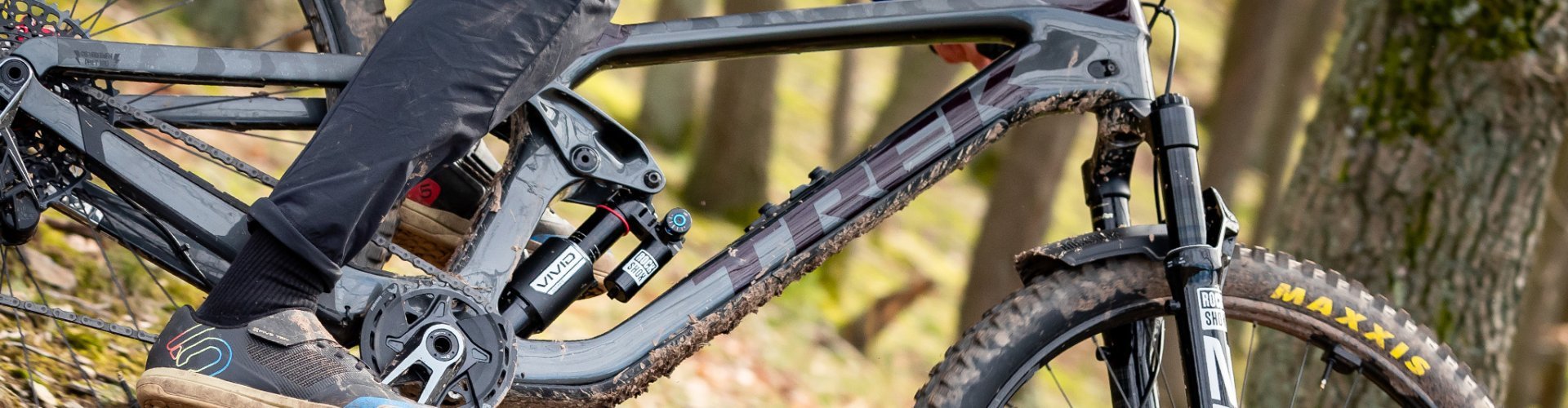
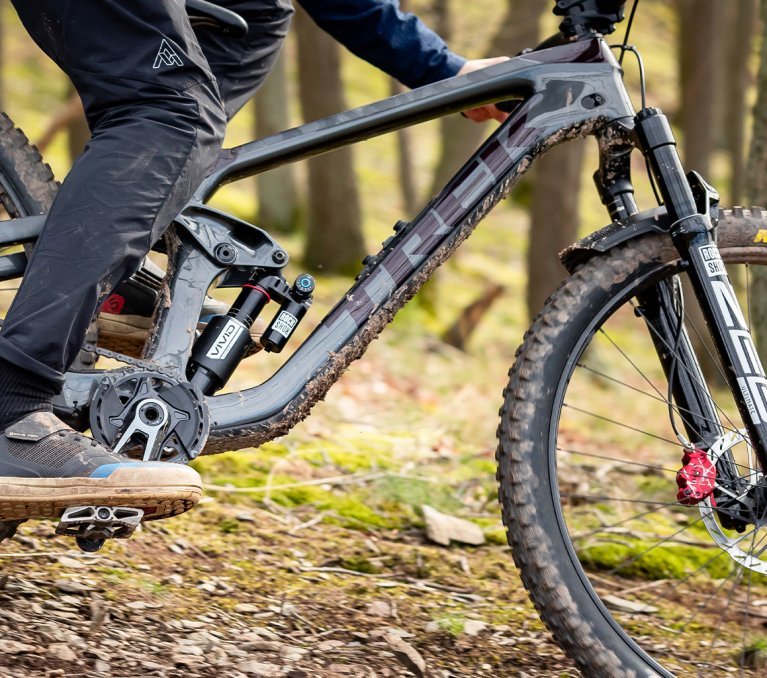
Many shock absorbers feature a small additional cylinder 'piggyback' style that serves as a reservoir for the damping oil displaced during compression. The piggyback contains gas that is compressed as oil enters it. The gas (usually nitrogen) is separated from the oil by a floating piston (IFP – Internal Floating Piston). During rebound, the gas pressure pushes the oil back into the main chamber. Between the main chamber and the reservoir sits the valve unit that controls damping. By outsourcing this reservoir, more space is gained for larger air and oil volumes, which benefits performance. Due to the bulky design, not every frame is suitable for piggyback shocks – on small frame sizes and/or with bottle cages, collisions can occur.
On most MTB forks, the stanchion unit consists of the fork crown and the inner, thinner legs, while the lower leg unit consists of the casting: the outer, thicker legs cast in one piece with the bridge. This design is often called Right-Side-Up. The alternative design is the upside-down fork (USD).
Between the stanchion and lower leg of a fork (or piston and main body of a shock) there are seals that protect the suspension element from dirt and water, and prevent the lubricating oil from leaking. The material, fit, temperature resistance, and other properties of the sealing and wiper rings primarily influence the sensitivity of a suspension element. They should generate as little friction as possible.
Regular service for fork and shock is essential to ensure flawless function and detect wear in time. A small service of the lower legs (clean, check for damage, and re-lubricate) should be done approximately every 50 riding hours. Modern suspension elements normally do not need additional lubrication from the outside. If you want to do this anyway, please use only the oil recommended by the manufacturer. The big service on the spring and damping unit including seal and oil change is due every 200 riding hours – or once a year.
Shims are the small metal discs that determine the oil flow in the damping of suspension elements by providing mechanical resistance (like a leaf spring). The shape, size, number, and arrangement of the shims create specific characteristics, e.g., minimum and maximum damping settings. A specific selection of shims is also called a tune. Multiple shims working together are called a shim stack.
A shock absorber generally refers to the suspension strut at the rear end of a full-suspension bike. In English, it's called a shock or rear shock. The shock has both a spring and a damping function; you must not confuse the shock (the component) with damping (the function). Either an air chamber or a steel spring (less commonly a titanium spring) is used as the springing element.
The shock eye is the part of the frame (or rocker link) to which the shock is mounted. Bushings are used for bearing to keep the shock mobile. Normally a shock requires two shock eyes; the exception is the trunnion mount.
With a shock pump you can inflate air suspension elements to the correct spring rate. It has a small volume and delivers high air pressure, often up to 300 psi (approx. 20.5 bar). Forks and shocks are equipped with a Schrader (car) valve. A precise pressure gauge is particularly important for accurate and reproducible suspension setup.
Shock stroke refers to the travel between the fully compressed and fully extended shock. Unlike with the fork, this value on the shock is not identical to the travel, as the frame contains a leverage ratio. The rear travel results from the kinematics and leverage ratio of the rear suspension and the shock stroke. Each frame has specified values for stroke and installed length. Usually, for technical reasons, no other variants may be used.
A spring curve graphically displays in a diagram how far, for example, the rear wheel compresses under the influence of a certain force. The X-axis usually represents the travel and the Y-axis the force, allowing progression to be visualized clearly. A linear spring is represented as a straight ascending line. The curve of a progressive spring is an ascending curve, since the force must be increased by an increasingly larger factor to compress the spring further.
See Air and Steel Spring or Elastomers and Leaf Springs.
The spring rate is the most important parameter of suspension. It determines how far a fork or shock compresses when a certain force is applied. With air suspension, the spring rate is variable and can be adjusted to the rider's weight using a shock pump. With steel or titanium coil springs, the spring rate is constant; a different spring must be installed to vary it. The preload of springs only affects negative travel (sag), not the spring rate itself.
When riding on rough terrain, ideally mainly the wheels move – the rest of the bike remains in relative rest. This is due to the suspension, which works between unsprung mass (wheels, lower fork, rear suspension, brakes, derailleur) and sprung mass (main frame, saddle, cockpit, and you) and decouples them. The lower the unsprung mass, the faster and more efficiently the suspension can react. More on this in our Suspension Basics.
The suspension decouples you and your bike from ground irregularities. It ensures traction and comfort. The wheels can compress (think of a rock you ride over) or rebound (e.g., a pothole, see also negative travel), without you having to actively compensate for this movement. However, suspension alone is only one side of the coin; the other is damping, which influences how controlled the compression and rebound occurs. Air and steel springs are used as springing media. Tyres also play an important role in suspension and damping. Components such as seat posts, handlebars, or stems also have flex, but are not covered here.
The suspension fork handles front wheel suspension and is the most commonly installed suspension element on bicycles. It is used virtually everywhere from mountain bikes in all their variants to city and trekking bikes to gravel bikes, and exists in various designs, of which the telescopic fork in Right-Side-Up design is by far the most common. In a suspension fork, springing and damping are used.
With suspension forks, there is a stanchion unit and a lower leg unit that slide into each other. The stanchions are always the part fixed to the frame. Lower legs are always connected to the wheel axle and work in relation to the greater sprung mass of frame and rider.
Metal springs are the second most common suspension element after air. They are now predominantly used on shocks. The coil spring offers particularly sensitive initial response, requires less maintenance than air suspension, and doesn't get as hot on long descents. However, the spring rate is constant – so you need a new spring if you want a harder or softer suspension. Steel springs are relatively heavy; titanium springs partially offset this disadvantage.
A telescopic fork refers to all forks in which the stanchions move into the lower legs, regardless of the spring medium and arrangement (upside-down fork). Alternative suspensions would include leaf springs, parallelogram forks, or elastomers.
Thru-axles are the common name for the wheel axles now used on mountain bikes. At the front wheel, diameters of 15 and 20 millimeters are found; at the rear wheel, 12 millimeters is most common. Note: There are different lengths and thread pitches! How to find the right thru-axle for your bike is explained here.
See Steel Spring.
Travel is the maximum distance the wheel can travel during compression. For the fork, travel is stated directly; for the rear end, it is calculated from shock stroke and leverage ratio (kinematics). On mountain bikes, travel is a fundamental distinguishing feature of the different bike categories, from cross-country to trail bikes, enduro, freeride to downhill.
At the end of the 2000s, the major suspension manufacturers developed forks with adjustable travel reduction. From RockShox, forks with U-Turn, 2-Step, and Dual Position Air were and are available; at Fox Racing Shox the function was called TALAS. The idea was to enable a more climbing-friendly geometry. However, modern geometries (slack head tube angle, steep seat tube angle, longer wheelbase) make these technologies superfluous for many riders.
Shocks with trunnion mount do away with the classic shock eye with bushing at one end; instead, the shock is bolted into the mount on the frame with one bolt from each side. Due to the more compact design without an exposed shock eye, the manufacturer can achieve more shock stroke at the same or even shorter installed length. This allows even frames with little space for the shock to provide a lot of shock stroke, benefiting performance.
In twin-tube shock struts, the damping oil can flow not only through the valves in the shock piston, but also around the outside through a double-wall design. This gives manufacturers more freedom to design complex damping systems with a larger adjustment range. The valves for controlling oil flow are usually located where the oil flows from one chamber to the other.
Pneumatic tyres are among the most important inventions that make bicycles the wonderful machines we love. They perform the basic function of suspension and damping on every wheel as the tyre flexes when rolling. In addition to air pressure, the size and construction of the tyre (carcass weave, material thickness, rubber compound) also determine the specific suspension and damping properties. Since the adjustability of these parameters and also the tyre travel is very limited, we install suspension elements such as shocks and forks.
Upside-down refers to forks in which the stanchions (fixed to the frame) are the outer legs, into which the inner lower legs (fixed to the axle) dive. The advantages are less unsprung mass and greater longitudinal stiffness. Since the lubricating oil always flows downward, the wipers stay better lubricated. Critics point to lower stiffness under lateral forces such as braking or steering. On mountain bikes, right-side-up forks are more common.
Spacers for the air chamber are among the simpler and more common tuning measures for forks and shocks. With their help, you reduce the volume of the air chamber in your suspension element, creating higher end progression – the further you go into the travel, the greater the resistance, preventing bottom-outs. RockShox calls these Bottomless Tokens or Bottomless Rings; Fox calls them Air Volume Spacers.
Sometimes manufacturers give air pressure recommendations for forks based on rider weight. These specifications refer to the ride-ready state, including equipment such as clothing, backpack, shoes, helmet, etc. For shocks, there are no such recommendations, as differences in kinematics make universal statements impossible. Frame manufacturers usually recommend a specific negative travel (sag), typically around 25–30% of total travel.
We hope the most important terms have been clarified and that we haven't left out anything essential. If you have more in-depth questions or think something important is missing, please let us know!
Ready for the season? We’ll show you how to prepare your bike for the upcoming season and which parts require special attention.

Air fork and coil shock with titanium or steel coils? We’ll go over the characteristics of different spring media for mountain bikes and e-bikes.

In order to fully utilise the potential of your mountain bike suspension, you should know its adjustment options and functions. We’ll explain them all!
Mountain bikes and E-MTBs come with suspension elements that rely on air or steel as the spring medium - or even titanium. We'll explain the differences.

Modern MTB suspension systems consist of a spring and a shock. We explain the differences so that you can find your perfect suspension setup more easily.
Send your unused goods back within 100 days after purchase and get your money back!
See more